
Musical Culture and Empire in Eighteenth-Century London

Throughout August 2020, IT&T in collaboration with the University of Warwick's Global History and Culture Centre and Early Modern and Eighteenth-Century Centre presents a digital series of performances and talks exploring the lives of musicians and their patrons in eighteenth-century London. The series will premiere on 4 August at 7pm. This blog post features an historical essay accompanying the concert series by Professor Maxine Berg, detailing the rich musical culture of eighteenth-century London and Britain more generally and its historic links to empire, slavery, and changing global patterns of consumption.

Introduction

The digital concert series connects eighteenth-century London, Europe’s greatest metropolis, as a European cultural centre to the city as a centre of empire. Britain’s empire by the early eighteenth century was not on the model of the territorial empires of her European neighbours, ranging from the Roman Empire to the Habsburg, French and Russian Empires. It was a maritime empire or an ‘empire of the sea'. By the 1760s the British Empire had come to mean Great Britain, Ireland as well as numerous British colonies and settlements across the world. Themes of global encounters, the exotic and empire formed some of the background for the reception and development of British musical culture during a period defined by Enlightenment, modernity and economic development. A culturally diverse musical society included composers and performers, audiences and benefactors connecting with Europe, the Atlantic world and Asia. The Warwick History Department currently has two interdisciplinary research centres where many of its participants are pursuing themes of empire, trade, global encounter, and enslavement. ‘Musical Culture and Empire’ brings musical culture to our histories, and this digital concert series supports today’s musical cultural sector during this period of Covid-19.

London, Empire and Luxury

By 1700, London was already Europe's largest city, and held 11% of Britain’s population. It grew from 500,000 inhabitants in 1700 to 675,00 in 1750 and reached 959,000 in 1800. 4,000 aristocratic and gentry families had homes in the city by 1700, stimulating the “London season”. The London season, coinciding with the sitting of Parliament from November to June, brought the aristocracy and gentry from their country to their London residences. It marked the cycle of cultural events and polite entertainment in the capital. It brought not just elite families to London, but migrations of professional and service classes, including musical and theatrical performers.

London in 1794

Another 4,000 merchants, bankers, and wholesale traders, as well as a third of all English lawyers generated a vibrant consumer culture: London was not just the largest city in Europe, but a city of empire, with a large mercantile and commercial culture. It was a centre for shipping, trade, and the navy, connecting it with Europe, the Americas, Africa, and Asia. Its commerce brought colonial ambitions; it became an entrepot of the world’s luxury goods. The slave trade is an integral part of its story. From early in the eighteenth century the Royal African Company and independent traders were sending an average of 60 slave ships a year to the West Coast of Africa and on to the Caribbean, returning with Britain’s new luxury foodstuff: sugar. London’s coffeehouses and sugar culture were part of a commercial culture conveyed in nearly 22,000 shops, warehouses and other retail outlets, as well as 200 leisure venues.

An extensive print culture of popular newspapers and news sheets, trade cards, bills and posters advertised all manner of goods and events. The Public Advertiser advertised many benefit concerts, musical performances and festivals, and there were large ticket-paying audiences. The first performance of George Frederic Handel’s (1685-1759) ‘Music for the Royal Fireworks’ attracted 12,000 paying spectators for the rehearsal alone. Johann Mattheson, writing early in the century, summed up the commercial possibilities for musicians:

‘He who in the present time wants to make a profit out of music betakes himself to England. The Italians exalt music: the French enliven it; the Germans strive after it; the English pay for it well.’

Musical events took place in the many theatres, and by the early 1740s in the pleasure gardens (especially Ranelagh in Chelsea), in the guildhalls, charitable foundations, and churches as well as specialist concert rooms. From the 1760s there were Hanover Square Concert Rooms (pictured below) and Pasquali’s Rooms on the new Tottenham Court Road.

The Hanover Square Rooms in 1844

The Hanover Square Rooms in 1844

The Royal Academy of Music was founded under the patronage of George I in 1719 to promote opera, also using funds from the slave-trading Royal African Company (1672-1752). George Frederic Handel became its inaugural musical director until his death in 1759. His prolific composition and performance fostered a great public enthusiasm for Italian opera and Italian singers, as opera became newly accessible to the middle classes. Handel also developed the popularity of the oratorio form. This saved on expensive theatrical staging and was ideal for many of the types of concert venues then available, for example the chapel of the Foundling Hospital, founded in 1740.

Provincial musical culture & sociability

This efflorescence of secular and sacred musical culture in the capital found its counterpart in the provinces: or the growth of Britain’s provincial and smaller towns far surpassed that of the rest of Europe, apart from the Netherlands. By the early eighteenth century 20-25 % of the English lived in towns, with over half of these in small centres of less than 5,000. Bristol had 50,000 inhabitants by 1750, Norwich, 36,000 and Newcastle 29,000. By 1800, Birmingham, Liverpool and Manchester were the largest, with populations ranging from c. 75,000 to 90,000. The spa towns and county and cathedral towns attracted members of the court, the gentry and the professional classes. Oxford, in its role as major university town and early musical centre, was populated by only 8,000 in the mid eighteenth century, and 12,000 by its end, but nevertheless one skewed to the elites and professions; by the 1730s it had three distinct musical societies. Musical culture and amateur traditions built on long-standing musical networks, while developing music clubs, subscription series and festivals, so that concerts became, by later in the eighteenth century, a nationwide pastime.

Instruments of Time and Truth rehearsing in Oxford’s Holywell Music Room for their concert, "‘Handel’s Youthful Exuberance” in February 2020

Instruments of Time and Truth rehearsing in Oxford’s Holywell Music Room for their concert, "‘Handel’s Youthful Exuberance” in February 2020

Music clubs combined a mixture of public and private events; music festivals included sacred pieces performed in churches, and secular pieces in other venues, such as The College Hall in Hereford. Towns developed their own specialist concert venues - from the Holywell Music Room (above) in Oxford in 1742, and St. Cecilia Hall, Edinburgh in 1762, to the Music Hall, Liverpool in 1786, and St. Andrews Hall, Norwich in 1788. For the most part music was publicly performed in commercial premises devoted to sociability and entertainment - inns, assembly rooms, theatres, the new pleasure gardens such as those in Bath, Norwich, Bristol, Birmingham and Newcastle.

There was a great deal of amateur composition and performance. Rich connections between popular and elite musical culture during the early modern period continued, although specific types of music making were increasingly associated with politeness and gentility. Music clubs and subscription series were expensive. James Harris’s subscription concerts in Salisbury, followed by John Marsh in Canterbury then Chichester. The Salisbury series cost the concert-goer two guineas a year; the Chichester series attracted 150 subscribers a year.

By the 1740s there were 53 oratorio subscription concerts; another 43 subscription concerts, and 45 concert series advertised. Geminiani’s subscription series at Hickford’s in 1731/2 cost 4 guineas for a 20-concert series; Handel’s 18 concert oratorio series in 1743 cost 6 guineas. Only the wealthy elite could afford to attend regularly at these prices. Many more did attend occasional concerts; tickets for professional-level concerts might be had for between 5s. and 10s.6d, the equivalent today of paying c.£75 to £160. And there was a great diversity of events to attend. Between 1672 and 1749 there were over 4,300 musical events advertised in the London press; as many were also advertised in the period from 1750 to the end of the century. By the end of the century large audiences were attending the festivals; 970 saw Haydn’s Creation at the 1800 Salisbury Festival.

While the cost of music listening could be high, domestic music-making needed not be. Many instruments could be had quite cheaply – a violincello for £5, violins for £2 to £3, an oboe for less than £2. But harpsichords and pianos did cost a lot, c. £35-50 guineas in the mid 18thC, and organs were very expensive. Organs were only just being replaced in the churches from the mid eighteenth century onwards, after their removal during the Commonwealth a hundred years prior. John Marsh of Chichester, not only a great impresario of concerts and orchestras, but an active composer and amateur musician, travelled about England playing on newly installed church organs.
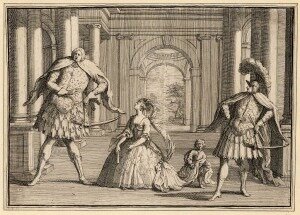
Senisino alongside Francesca Cuzzoni and Gaetano Berenstadt in a production of Handel’s Flavio

Senisino alongside Francesca Cuzzoni and Gaetano Berenstadt in a production of Handel’s Flavio

Fees for professional musicians ranged widely from £30 to £100 a year during the 1720s for members of the orchestra, and wind and brass instrumentalists could be recruited for particular series or events from the many military bands quartered about the country with their regiments. But the well-funded Royal Academy’s lead singers were highly paid; a famed castrato like Senisino (pictured above) could claim £1500, and the soprano Margherita Durastanti £1100. Handel’s salary as music director was £700.

The Charities and Empire

A key platform for developing English musical culture during the early to mid-eighteenth century were the charities: hospitals, almshouses, schools and orphanages. The Foundling Hospital, established in 1742, particularly became associated with the modish music set. Handel became closely involved in the fundraising, and also found it in a new venue for benefit concerts. An audience of 1,000, including the Prince and Princess of Wales attended his benefit concert in 1749 in aid of the completion of the Chapel; he held the first benefit concert of Messiah there in 1750, donated an organ, and became a Governor. He held annual concerts of Messiah after this, raising £7,000 overall. Handel’s close musical associates, Charles Jennens (1700-1773), Messiah’s librettist John Christopher Smith, Handel’s secretary and copyist and first organist at the Foundling Hospital, and the tenor John Beard (1717-1791) were all closely involved in the project.

The association between music and the charities also takes us back to the inequalities, diversity and sources of income in London as Europe’s great imperial city. There were approximately 10,000 people identified as black in eighteenth-century London. What was their part in the musical history of this city of empire? Here, as with the lives of so many ordinary people from the eighteenth-century, we know very little. A number came to London as slaves and became servants; some were well-educated, including in music. The most famous case is that of Ignatius Sancho (1729-1780), former slave turned composer, musician, and writer, after also earning his living as a grocer.

Ignatius Sancho

Ignatius Sancho

George Bridgetower

George Bridgetower

George Polgreen Bridgetower (1778-1860), came to London from Europe; he played at the Bristol Assembly Rooms in late 1789 and early 1790 as a prodigy, then across the London theatres during the next ten years. His musical education was fostered by the Prince Regent, and he went on to develop a European as well as British concert career. He holds enduring fame as the former dedicatee of the Beethoven Kreutzer sonata. Joseph Antonio Emedy (1775-1835), a former Portuguese slave, became a virtuoso violinist and composer, eventually becoming the leader of the Truro Philharmonic Orchestra. On a wider scale there is evidence of black soldiers in the military regiments stationed around the country, and some of these may well have been part of the military bands whose members also took part in wider orchestral concerts. But whatever their origin, our knowledge remains limited on who so many of eighteenth-century Britain’s musicians were.

Handel, benefactors and the Royal African Company

Many of the benefactors of the charities along with the elite followers of the charity benefit concerts had grown rich on Britain’s new trade and imperial wealth. A number of the original investors in the Royal Academy of Music were also shareholders in the Royal African Company and the South Sea Company (1711-1853). Both of these companies traded in slaves, though the Royal African Company ceased to do so in 1731, turning its activities to ivory and gold in the hope of clawing back from the brink of insolvency. Handel himself held shares in the Royal African Company in May, 1740 (he was paid in them), but continued to hold South Sea annuities as a holding place for transfers of fees and salary between 1723 and 1732. He was not alone; a number of the original subscribers to/investors in the Royal Academy of Music (1719-27) held shares in the Royal African Company.

There is a legacy in the imperial context of British musical culture, for Handel’s most famous manuscripts were held by two families that had owned large plantations in Barbados and Antigua. The manuscripts of the Granville family are now held by the British Library. The first performing score of Messiah, once owned by the Ottley family is now in the Bodleian Library. We are now learning just how much of Britain’s economic and social infrastructure was funded by the profits of slavery and compensation for abolition; so too was its cultural infrastructure, including scores and musical instruments. Wealthy families engaged in the slave trade and used this financial capital to build up cultural capital in the musical culture of the day, hiring musicians, purchasing manuscripts and scores, and musical instruments and funding concerts.

London as a European musical metropolis was also the centre of a rapidly growing British economy, now embedding itself in a wider global empire. It attracted musicians, audiences, benefactors and patrons from well beyond its traditional European networks. This was not just the story of one metropolis, for Britain’s distinctively urban profile ensured the wide dispersal of a rich musical culture of performers and concert goers. With wealth partially funded by empire, the British commercialised their culture, importing, adapting and developing a great variety of musical forms and staging these in many new venues. Increasingly audiences came not just from the elites, but from many in the middle classes. This commercial and amateur musical culture was not just London’s achievement, but was widespread across the country.


Further Reading

Maxine Berg, Luxury and Pleasure in Eighteenth-Century Britain (Oxford, 2005).

Helen Berry, The Castrato and his Wife (Oxford, 2011).

Helen Berry, ‘Gender, Sexuality and the Consumption of Musical Culture in Eighteenth-Century London’, in S. Hindle, A. Shepard and J. Walter, eds., Remaking English Society: Social Relations and Social Change in Early Modern England (Woodbridge, Suffolk, 2013).

Peter Borsay, The English Urban Renaissance: Culture and Society in the Provincial Town 1660-1770 (Oxford, 1989).

Peter Borsay, ‘Concert Topography and Provincial Towns in Eighteenth-Century England’, in Susan Wollenberg and Simon McVeigh, eds., Concert Life in Eighteenth-Century Britain, (Farnham, Surrey, 2004).

John Brewer, ‘Culture as a Commodity; 1660-1800’, in Anne Bermingham & John Brewer, eds., The Consumption of Culture 1600-1800 (London, 1995).

John Brewer, The Pleasures of the Imagination: English Culture in the Eighteenth Century (London, 1997).

Catherine Harbor, ‘The Marketing of Concerts in London 1672–1749’, Journal of Historical Research in Marketing, July, 2020.

Ellen T. Harris, ‘”Master of the Orchestra with a Sallary”: Handel at the Bank of England’, in Music and Letters, 101, 2020.

Douglas Hay and Nicholas Rogers, Eighteenth-Century English Society (Oxford, 1997)

David Hunter, ‘Handel Manuscripts and the Profits of Slavery: the Granville Collection at the British Library and the First Performing Score of Messiah Reconsidered’, Notes (December, 2019), pp. 27-37.

H.D. Johnstone, “Handel's London - British Musicians and London Concert Life”, in D. Burrows, (ed.) The Cambridge Companion to Handel, (Cambridge, 1997), pp. 64-77.

Paul Langford, A Polite and Commercial People. England 1727-1783 (Oxford, 1989)

Simon McVeigh Concert Life in London from Mozart to Haydn, (Cambridge, 1993).

Simon McVeigh, Calendar of London Concerts 1750–1800, Goldsmiths, University of London, http://research.gold.ac.uk/10342/ (accessed 29 July, 2020).

Christopher Marsh, Music and Society in Early Modern England (Cambridge, 2010).

Walvin, James, ‘Ignatius Sancho: The Man and His Times’ in Reyahn King (ed.). Ignatius Sancho: An African Man of Letters (London, National Portrait Gallery, 1997)

Susan Wollenberg, Music at Oxford in the Eighteenth and Nineteenth Centuries, (Oxford, 2001).

Susan Wollenberg and Simon McVeigh, eds., Concert Life in Eighteenth-Century Britain, (Farnham, Surrey, 2004).

New Administrator Announced

Instruments of Time and Truth is pleased to announce the appointment of William Anderson as its new Administrator. Will may already be a familiar face to Oxford audiences as a member of Christ Church Cathedral Choir and the Oxford Bach Soloists, as well as the Administrator of the Oxford Chamber Music Festival. We are delighted that he is taking up the post and Judith and Gay are thrilled to be welcoming him to the team.

Newsletter April 2019

Newsletter April 2019

I am currently sitting in bed nursing a sprained ankle which provides me with the opportunity for a long-overdue newsletter.

IT&T: Then and Now

I just skimmed through the January newsletter to remind myself of the events which have already taken place this year and am amazed at how few have actually involved me. For the first time, I am faced with tangible evidence of the growth of IT&T. I remember on September 23rd 2015 being in the box office at the Holywell Music Room in my concert clothes and realising, in a panic, that the orchestra was going on stage without me. Gone are those days when we were almost literally a one-man band and nowadays, our growing network of volunteers and supporters has taken much of the stress out of the logistical side of putting on concerts. I must thank Joelle Mann for her infectious enthusiasm and ability to charm punters into accepting donation forms (and even filling them in), Elizabeth Adams for her quiet capability and experience with the various Oxford venues, Jitka Fort for being there throughout, our trustees and the amazing Jessica Osborne who has rescued our books from the chaos wrought by one double bass player attempting to act simultaneously as fixer, distributer of flyers, poster putter-upper, accountant and occasionally, musician.


The day to day running of IT&T is still acheived by 3 people: myself, Gay Amherst and Aliye Cornish. Only Aliye is paid a modest hourly rate and she brings the youthful energy and technical savvy that is the powerhouse behind getting things done. Aliye is single-handedly responsible for the ambitious IT&T InSpires, our unique education project which aims to bring historically-informed performance into the mainstream for future musicans, which is already benefitting young performers in Oxfordshire. In the course of creating and running the project, Aliye has become incredibly effective in attracting funding for our work and has recently garnered donations from the Bishopsdown Charitable Trust, the University Community Fund, the Doris Field Charitable Trust and the British Croatian Society.


Staying true to our ethos
But despite having expanded, IT&T remains firmly committed to its ethos - that of providing concerts of the highest possible musical standard at the lowest possible cost. We still travel together, bake each other cakes and try and think collectively about using Arts funding as efficiently as possible. Not a penny is wasted.


You are invited to our 5th Birthday Party
Of course, fund-raising still lies at the heart of any charity's existence and since having had Development funds made available to us from Woodford Investments, we are much more focused on this as a priority. You may be aware of our 5th Anniversary Appeal - our bid to raise £10,000 in a hundred days. The hundred days will be up on June 5th when we host our 5th Birthday Party which happily coincides with the birthday of one of our staunchest supporters, Lady Margaret Bullard. If you would like to donate or become a Friend in time to attend the party, be entertained by Bojan Cicic and Chris Bucknall and meet the musicians, then please sign up via the website. The ebullient William Purefoy will act as auctioneer in our auction of promises which includes stays on the coast in Cornwall and Dorset, a flight in a private plane, as well as things we could all do with, like help in the garden. So please think about joining us, we would love to meet you and we are looking forward to a night where we allow ourselves to celebrate everything we have acheived over the past 5 years. Do hurry - we only have 14 tickets remaining.


2019 so far...
So, finally, to the music. Freelance musicans are traditionally unemployed in January and February, following the flurry of Christmas Oratorios and Messiahs, so IT&T’s continued activities in February were welcomed by the musicians (and hopefully the audiences): our Monteverdi Vespers with the Summertown Choral Society; Musica per la Sera and a side-by-side concert with The Bate Players and Oxybaroxy as part of the Keble Early Music Festival; as well as Digital Spaghetti in the Wotton Concert Series.
More recently, we have performed the St John Passion in Barnes with Tiffin School and, as I write this, IT&T is engaged in a tour of 3 performances of the same work in Spain. Closer to home, we very much enjoyed performing Concertos and Curiosities in the Holywell Music Room on March 23rd on the same evening that members of IT&T took part in Dido and Aeneas in New College Chapel! The audience in the Holywell were treated to two relatively unknown suites by Telemann and W F Bach (definitely the ‘Curiosities’ of the title), alongside J S Bach’s harpsichord concertos in D major and A minor - think C18th Heavy Metal! Our next Oxford appearance will be on April 14th at 5pm in Merton College Chapel in Bach’s St Matthew Passion, conducted by Ben Nicholas. Please see our website for booking information.


Fitting Finale for the 2018/19 Season
The final official concert of our 2018/19 Season takes place in SJE on May 25th. ‘Musick Restor’d’ or ‘The King shall Rejoice’ sees IT&T performing once again with Edward Higginbottom’s much-acclaimed Oxford Consort of Voices. With its programme of quintessential English music by Humfrey and Purcell (including his Ode to St Cecilia) and the added attraction of an appearance by actor, Tom Bateman, this concert promises to be a fitting conclusion to our vibrant Season. It is also the first live performance of music from our CD of Symphony Anthems which will be available on the night.


Special treats
A couple of late additions to our programmed events will take place on June 1st. The first is a soiree at Worton Organic Garden where Bojan will perform, accompanied on the lute and guests will be treated to a mouth-watering supper prepared with literally the freshest organic ingredients from the eponymous garden (we have an a number of tickets reserved exclusively for Friends). The second is a rather special Evensong at Magdalen, where we will perform Bach’s Magnificat. I would describe both these events as examples of the privilege we enjoy living in Oxford and I hope you will take advantage of these opportunities. 


Summer Festivals
That leaves us with one of the great features of our Temperate climate: the Summer Festival. Whether performed, audaciously, in the outdoors, or undercover, these festivals celebrate the special atmosphere of our light evenings. Where, half the year we are huddled in our dingy Victorian houses, we now surface into the light which lends every occasion a frisson of enjoyment, somehow enhanced by what has gone before and must come after.


Join us on 23rd June at Oxford Festival of the Arts for ‘Purefeo’ with William Purefoy, Helen Parker and Rebecca Bottone or on July 7th in the Assembly Rooms, Bath, as part of Martin Randall Travel’s West Country Choral Festival.


To be continued...
Plans are already well-advanced for our 2019/20 Season. Our opening concert on Friday, October 4th at the Sheldonian features Bojan Cicic in what can only be his original take on the Beethoven violin concerto. A musician of immense sensitivity and integrity, Bojan offers something far more profound than the swagger of a viruosic showman. Conducted by Edward Higginbottom, this concert unites these two exceptional talents. Do come along and, for this Season, perhaps you will bring along 1 new concert-goer each time.


For your diary, our ‘candlelit’ Messiah (health and safety-approved) takes place on December 21st at 5pm. Booking will open in September and this event will sell-out.
Later in the Season we will feature concerts directed by Bojan and by Chris Bucknall, as well as a further larger scale performance with Edward.
Further plans include a Monteverdi Vespers with Owen Rees and choir of The Queen’s College as part of the Divine Office Festival in 2020 and two projects in Malta, IT&T having been recommended to the Valetta Festival by the Director of St John's, Smith Square following our performances of The Triumph of Time and Truth.


Who we are
So our name is disseminated abroad, but Instruments of Time and Truth belongs in and to Oxford. It would be impossible to overstate the importance of each individual concert-goer. You are the lifeblood of the orchestra and IT&T will exist for as long as you demand it. Bring your friends, become Friends and make a personal investment in Oxford’s cultural identity. Thank you.

Judith Evans
Orchestra Manager


IT&T secures support from the Bishopsdown Charitable Trust

We are pleased to have heard that the Bishopsdown Charitable Trust will be supporting our IT&T InSpires scheme in 2019. Our vision is to make it possible for all 11 to 18 year olds in Oxfordshire to experience workshop and live performance opportunities, as well as working with historical bows and instruments. Historically informed approaches to performance have a wonderful potential for students to learn about the science, evolution and development of instruments, as well as the historical and social contexts of the music. This scheme is unique in Oxfordshire and we are delighted to be delivering it in partnership with the Oxfordshire County Music Service.

Newsletter November 2018

An American colleague of mine sometimes wears a t-shirt telling us that ‘Life is short; Opera is long’. If you live your life caught in the jaws of this dichotomy between brevity and urgency then you probably understand the textspeak TL; DR. In which case might I redirect you to our ‘At a Glance’ which Aliye will be forwarding shortly. This newsletter is particularly long and contains very little news. 


Having borrowed from Handel in choosing our name, it seems only fitting that ‘The Triumph of Time and Truth’ can now be used to describe IT&T’s activities this Autumn. Not only did the oratorio form the backbone of our Autumn concerts with performances at the Tetbury Festival, King’s Place, London and the Sheldonian, but to my mind it identifies a shift in IT&T’s presence and a feeling that the orchestra is now being embraced by the Oxford audience. 


Our season began in September with Digital Spaghetti, a fitting platform for the talents of our virtuosic leader, Bojan Cicic. When I first heard Bojan perform Locatelli’s Il Laberinto Armonico about 6 years ago, my reaction was to laugh in disbelief – not only that a composer would write something so mad, but that someone could actually play it. Ever since I have wanted everyone to hear Bojan perform that piece, and to realise the extent of his talent. I loved that we made our concert in the Holywell Music Room on September 22nd happen, for that reason. I think of Digital Spaghetti as the ‘thinking man’s totty’ of baroque music, in that it combines sophisticated composition with an irresistibly popular appeal. It’s the sort of programme we perhaps don’t get enough of in Oxford, a sort of guilty pleasure amidst a landscape rich in intellectual challenges. 


But there is no shame in enjoying Art – I am most definitely in Philip Larkin’s camp here. His ‘enormous Yes’ epitomising what the arts mean to me – the ultimate affirmation of humanity and human experience. 


This feels particularly apposite as I return from the latest Charity Futures conference in London. This is the third consecutive year I will have had the privilege of attending this conference at the invitation of Woodford Investment Management, and it is always a remarkable experience. 


As a classical musician one can often feel like a fly-on-the-wall of real life: nothing ever seems to apply to us – categories and surveys never allow for the vagaries and uncertainties of a musician’s life, and people look blankly at me as I try to explain why I can’t regularly attend on a Tuesday, or why I shouldn’t pay exorbitant car insurance because, despite being ‘an entertainer’, I don’t give lifts to celebrities. 


It’s a bit like that at Charity Futures. These are all intelligent people with proper jobs in challenging and worthy fields. They also understand what the speakers are on about and ask probing questions at the end. But no matter how alien an environment it can feel to a musician who also helps run a charity which has one administrator and three volunteers, there always comes a moment when I want to get up and shout, “That’s us! That’s what we do!”


This year that moment came when Roman Krznaric, who addressed ‘Planning for The Long Now’ (the need to think not in months but in millennia), asked us to discuss with our neighbour our most important experience of ‘Long Thinking and what it meant to us.’ Suddenly the Alien became the Native, for ‘The Long Now’ is where we classical musicians live. In particular early musicians trying to imagine and reproduce the vision of composers from hundreds of years ago, and act as conduits in entrusting that legacy to future generations. One of the intended interpretations of the word ‘Instruments’ in our name. 


It is ironic that the moral of Handel’s oratorio ‘The Triumph of Time and Truth’ is belied by its very existence. Handel might have us believe that Beauty is transient and only Truth endures. But Art alone can be both beautiful and true. One wonders if Handel was a Long Thinker and if he is smiling now. 


One of the other speakers at the Charity Futures conference was Andrew Mackay, a former senior officer in the British Army who commanded 9,000 soldiers in Afghanistan. Central to his story was his need to know why he and his troops were in Helmand and how he had gone about answering that question and validating their presence there. 


Again that sort of question is in our minds this weekend and is underlined by our Sheldonian concert this Friday, In Memoriam. Ticket sales are always an anxiety for a group in its infancy, but alongside our annual Messiah, In Memoriam promises to be our largest audience ever. Proof surely of the enduring power of music to express those ‘Thoughts that do often lie too deep for tears’ and which we, as humans, will continue to experience. 

Judith Evans, Concerts Manager

Two Minute Read - Nick Pritchard

Tenor Nick Pritchard joins IT&T for ‘The Triumph of Time and Truth’ in October, as well as the ‘Messiah’ by candlelight on December 22nd.

Tenor Nick Pritchard joins IT&T for ‘The Triumph of Time and Truth’ in October, as well as the ‘Messiah’ by candlelight on December 22nd.

You are joining IT&T for Handel’s ‘The Triumph of Time and Truth’ in October, and his Messiah on December 22nd. Do you have a particular favourite among Handel’s works? And if so, what is it about this piece which distinguishes it above the others? 

It's a total cop-out to say, but there are just too many pieces that do so many different things to pick out just one! Obviously The Messiah is one of Western Culture’s pillars of achievement, and I adore the fact that it takes up most of my time every December, but I have a soft spot for his Ode to St. Cecilia for its range in representing so many magical facets of music and Jephtha is a total gift for a tenor and is dramatically utterly gripping (the same goes for Samson!). I could listen to his Concerti Grossi all day too.


Having been a choral scholar in Oxford was the transition into opera something that you had always wanted to do?

Yes, I think so, although I've never been one for a ‘five-year plan’, so it wasn't something I necessarily intended to move on to, but I did a lot of it while at university, and loved it all. While stage work is very important to me, concert repertoire is a big part of my professional life too, so the time I spent as a Choral Scholar has proved invaluable to the stuff I do now. The daily commitment, the teamwork and the level of musical excellence needed in that environment were all steep learning curves for me, which have provided skills I use daily. Work in the choir stalls and on the opera stage are more linked than people realise, I think! 


Which projects, professional or personal, are you particularly looking forward to in the coming months? 

Professionally, I'm looking forward to a recital in the Oxford Lieder Festival with fellow ex-New College musician, Ryan Wigglesworth, doing some Bach Cantatas with Harry Bicket and The English Concert at the Wigmore Hall, Bach’s Easter Oratorio with the BBC National Orchestra of Wales, and his St. John Passion in the USA with Jonathan Cohen, back home in London with Stephen Layton and the OAE, and of course in Spain with IT&T!

The ‘project’ I'm looking forward to the most though, is getting married at the end of the year to my wonderful fiancée, who is also singing with IT&T this month in the choir. It's certainly taken up a lot of our time recently, but we can't wait!

Nick joins IT&T for Handel’s ‘The Triumph of Time & Truth’ this month.

Newsletter May 2018

Corporate support for IT&T
For the last couple of years, IT&T has been fortunate enough to be amongst the many charities receiving support from Woodford Investments. As such, we have been afforded a glimpse into a very different environment from that of Baroque music and benefitted from the type of thinking that goes into building a successful business - until relatively recently, an approach quite alien to the Early Music world.
 

Developing IT&T
IT&T is now firmly established as a local community resource. Only last week I received enquiries for four concerts from a variety of local sources which is hugely gratifying and encouraging. But we don’t want to be satisfied with that - we are still pursuing our ambition of establishing a regular concert series in Oxford and of becoming a regional presence. Last month, Woodford’s way of thinking had me meeting a fundraising consultant in London, with a view to establishing a development strategy for IT&T. I find this business approach fascinating: with grandparents who ran a Gentleman’s Outfitters in Rhyl I have always suspected that perhaps I am closer to a shopkeeper than a musician!
 

IT&T needs you!
Anyway, the good news is that we are actually doing a lot of the right things and that time and stamina will do much for IT&T’s development. The even better news is that our instinct that you, our audience, is our greatest asset has been officially confirmed, which somehow makes me feel more courageous about involving you. Establish a significant following and a market for IT&T and the rest will follow.
IT&T has developed at an unprecented rate in the last four years, with the result that we now need your help- there is simply too much ground for Gay, Aliye and myself to cover. That help might come in many shapes and sizes - let me give you an example: the most recent addition to the IT&T ‘office’ is Jessica Osborne, a Friend with accounting experience who has taken over the day to day finances of IT&T and provided very welcome relief from this considerable responsibility. We are hugely grateful to Jessica and fortunate to benefit from the expertise she brings with her. We know the IT&T audience has talents in abundance - fundraising and marketing skills would be invaluable, but even if you don’t possess these, you could still hold the key to increasing the number of our supporters and improving our resilience. 
 

The Grapevine
Very early on we established that word of mouth was our most effective marketing tool and we have now been advised to capitalise on what is essentially an extension of this, by tapping into existing networks with a connection to our audience. Your network might be a Residents’ or Neighbourhood association, a choir, or a company noticeboard, whether real or virtual. You might simply forward our ‘Forthcoming concerts’ to people who live in your road, or buy an extra ticket for a friend, or possibly you work for a company that could be persuaded to sponsor a local entreprise if we were to encourage them with a couple of complimentary tickets? Another possibility is arranging a fundraising concert in your home or that of someone you know, with suggestions of people we might invite as potential sponsors.
 

Getting involved
On a more practical level, we always need volunteers at concerts, so if you fancy ‘playing shops’ in the box-office or schmoozing potential donors at a drinks reception, do let us know! All of this support would help us and would nurture a genuine feeling of ownership in IT&T which is our ambition for Oxford.
In order to facilitate this new initiative, you will be sent our ‘Forthcoming concerts’ in a separate email!
 

The news bit
We are now in the final third of our 17/18 Season, but with many enticing events still to come. We very much hope to see you either performing with the Summertown Choral Society on May 19th (there’s a network!) or at one of IT&T’s exciting new collaborations in June and July. If you plan to attend our intriguing Friends’ soirée at Worton Organic Garden on June 2nd, why not bring someone new to IT&T with you? Finally, do come and support us in the sumptuous surroundings of Longborough Opera and enjoy the quintessential musical experience of the English summer.

Judith Evans
Concerts Manager

Newsletter March 2018

Hayes disc released

Definitely the most exciting moment so far in the journey that is IT&T was hearing the opening bars of ‘Ceremonial Oxford’ for the first time - our own tiny claim on immortality! Details of the release later in this Newsletter - do order your copies online and support an Oxford choir and orchestra performing the music of an Oxford composer which, together, we made happen.

IT&T’s progress

I remember, about this time last year, looking at the IT&T diary and marvelling at the orchestra’s rate of development since 2014. I thought that, possibly, novelty was playing its part and the level of sustainable activity would settle after a couple of years. On the contrary, it continues to increase apace and I am literally in awe of IT&T’s success. As I have said before, the feeling is less that we have carved out a niche and more that we have uncovered a pre-existing niche in this extraordinary city.

It was a great moment when Aliye produced our 2017/18 brochure - evidence of increased financial resilience bringing with it the potential for forward planning. I knew one or two dates would come in after publication, but in fact, the orchestra’s season has increased beyond all expectations with a breadth of activity which has resulted in an inspiring and fulfilling work environment for the many musicians we have been able to employ. I hope our existence has also enhanced the lives of our audience, participants in our workshops, worshippers at evensong in various colleges and aspiring professionals who have played alongside us.

2018 so far...

Since our Season brochure has been overtaken by events, you will be updated in this Newsletter, but, before that, a quick recap of the last few weeks.

January and February are traditionally ‘resting’ months for freelance musicians following the flurry of Christmas concerts, but not so for IT&T. Early January saw a four-day project with the University baroque ensemble, ‘The Bate Players’, culminating with a side by-side concert in New College Chapel on January 12th. Led by IT&T’s leader, Bojan Cicic, this was a fascinating exploration of seventeenth and eighteenth century string music - Bojan’s area of expertise. As a double bass is not generally used in this repertoire, but the Bate Players include a double bass player, I was exposed to this music myself for the first time. I definitely learned as much as any of the students and felt there was a tangible exhilaration in the concluding performance. This is the sort of experience I would have loved to have had as a music student - to play alongside seasoned professionals on the same desk, but for me now, as that seasoned professional, the experience was equally valuable. It is a wonderful thing to perform beside a burgeoning musician. The professionals bring a well-honed instinct for timing, musical function and ensemble, which is combined with the students’ youthful energy and passion. The result is always stimulating and at its best you even get a sense of that elusive elixir which is Creativity.

In contrast, The Bach Project part II: the Concerto, found us playing a very different role. IT&T’s Dan Edgar performed alongside predominantly ‘modern’ violinist Alexander Janiczek in Bach’s Concerto for two violins, we also accompanied James Boyd in what some think is a spurious concerto for viola and were then joined by Natalie Clein for a performance of the Sixth Brandenburg Concerto, featuring IT&T’s Rachel Byrt alongside James Boyd as the two viola soloists. This idea of combining modern musicians and those dedicated to historically-informed performance is a controversial one, but again, as in the collaboration with the Bate Players, at its best both parties learn from and inspire the other.

On February 6th, Headington School hosted ‘A Day with IT&T’, for GCSE and A level students presented by Jeremy Summerly of St Peter’s College. The initiative of Headington’s new Head of Music, Aimee Bassett, students sang, played, listened and hopefully learned. Feedback from the day was extremely positive.

Then followed IT&T’s two appearances at the Keble Early Music Festival: Edward Higginbottom’s Abendmusik on February 22nd with a programme of his favoured French baroque music; and on the 24th a concert of Mozart’s Jupiter symphony and Requiem. This was a real highlight for me. It is rare these days for an early music group to perform this repertoire except with a choral society because the cost of the brass instruments can be prohibitive. While accompanying amateur choirs is a valued part of IT&T’s work, playing the Requiem with Keble College Choir again had the same appeal as playing alongside the Bate Players. To be immersed in the sound of those young voices, many of whom are performing the Requiem for the first time, is extremely moving.

That brings us to March and the busiest time in the baroque musician’s diary: Easter. March 4th saw a trio of IT&T musicians performing in Buxtehude’s Membra Jesu Nostri at evensong in St Edmund Hall, then the 6th was the first of IT&T’s three performances of Bach’s St John Passion, this one in Somerville College Chapel, conducted by William Dawes. This is followed by another performance of the St John on Saturday in Peterborough Cathedral conducted by Steven Grahl, who has just been appointed Director of Music at Christ Church. Our third St John Passion is on Sunday, with New College Choir under Robert Quinney (tickets available only to Friends of IT&T). We hope to see many of you there.

Our final concert in March is with the Merton College Choir under Ben Nicholas in Bach’s B minor Mass on the 25th. Please see the website for booking information.

Following a break for Easter, IT&T will next be appearing in the Holywell Music Room on April 27th in the third instalment of the Bach Project. With eminent soloists Claire Booth and Ian Bostridge this promises to be a treat for both players and audience alike.

Looking ahead, another treat for Friends of IT&T is Jonathan Rees’s performance at Worton Organic Garden on Saturday, June 2nd which forms the second part of our series, ‘All Roads Lead to Bach’. This recital will be accompanied by a delicious meal of organic produce from the garden and I know it will be a very special evening.

IT&T is looking forward to our new collaboration with the Oxford Bach Choir in the Sheldonian on June 9th, followed by another new collaboration, this time with Magdalen College Choir on July 1st.

Perhaps I should apologise for this Newsletter being so long, but hopefully, even if you don’t read it, you will enjoy with us this evidence of Oxford having taken IT&T to its heart.

Judith Evans