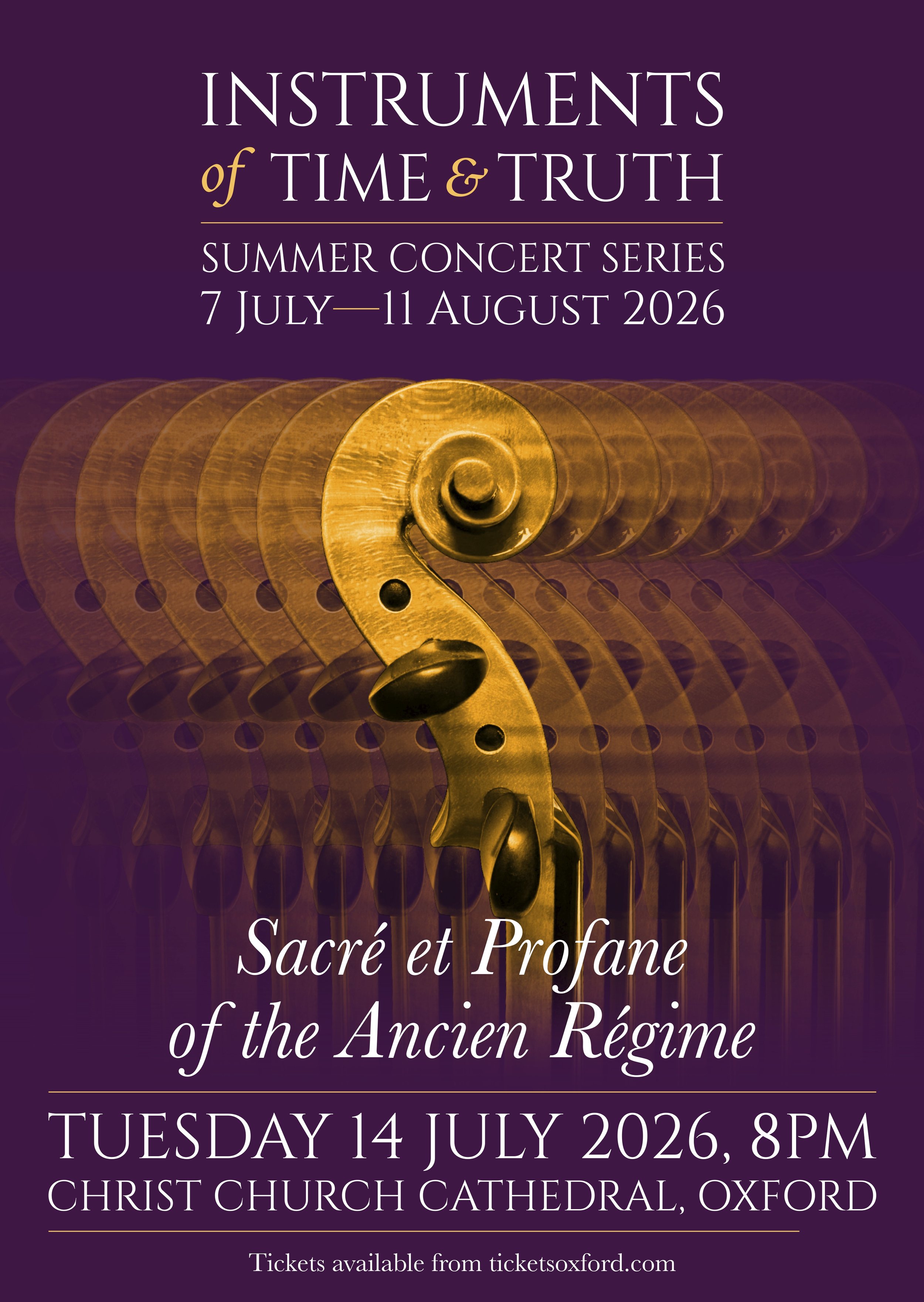
Sacré et Profane of the Ancien Régime
We warmly invite you to join us on Tuesday, 14th July at 8pm for the second concert in our Summer Concert Series at Christ Church Cathedral, curated by Edward Higginbottom. Marking Bastille Day, this programme explores the sacred and secular music of the French Ancien Régime through works by Michel-Richard de Lalande and Marin Marais.
As part of the 300th anniversary of Lalande's death, the programme centres on his Leçons de Ténèbres, interwoven with music for the basse de viole by Marin Marais.
Below, Edward introduces the thinking behind this carefully conceived programme in his own words.
Programme
M.-R. de Lalande, 3e Leçon du mercredy saint (soprano)
Marin Marais, Chaconne in G (Pièces de viole, bk I)
M.-R. de Lalande, 3e Leçon du jeudy (hautecontre)
Marin Marais, La Sonnerie (La Gamme)
M.-R. de Lalande, 3e Leçon du vendredy (sop & htc)
Performers
Caroline Halls (soprano)
Edward Beswick (hautecontre)
Susanne Heinrich and Jacob Garside (violes)
Edward Higginbottom (harpsichord)
Tickets
Tickets available on the door
Edward Higginbottom writes of the programme:
”Many French composers of the ancien régime tested themselves on settings of the Lamentations of Jeremiah, a staple of the liturgy for Holy Week. The style estalished by such as Michel Lambert was that of an ultra-expressive monody, or solo, although some composers ran to a duo for the last 'leçon' in a group of three. These readings from the Old Testament Book of Lamentations are attributed to the prophet Jeremiah. They bewail the fall of Jerusalem, evoking the desolation of a people which had lost its spiritual and cultural home. In the same way, they speak of the desolation of the Church as in Holy Week Christ's suffering and crucification is recalled.
Properly speaking, these texts belong to Matins, the earliest of the monastic offices, but too early for the beau monde to attend. A usage was established to allow the office to be sung at a more convenient time of day, during the evening of the preceding day. Thus the Lamentations set for Holy Thursday were sung on Wednesday evening. And thus these leçons for Thursday are styled 'pour le mercredy'.
Lalande's approach to the task is the traditional one: to present each of the verses as a distinct 'récit', varying the pace and content of the setting through the several verses of each reading. The music can be sung either by a soprano or a high tenor. In the performance by IT&T, both voices will take it in turns.
Interspersed will be music by Marin Marais, the great early 18th-century composer of music for the basse de viole. It's music that belongs rather more to the salon than the église, but in the high seriousness of the G major Chaconne from Marais' first book of viol pieces, and then the evocation of the bells of Ste Geneviève du Mont in 'La Sonnerie', we are not far removed from an ecclesiastical context.
This is music rarely heard, but of a rare beauty. The performance by IT&T marks the 300th anniversary of the death Michel-Richard de Lalande in 1726. Lalande was the greatest of French composers of the music for the Royal Chapel over a period of more than 30 years.“
Biographies
Edward Higginbottom
Before moving on to St Mary’s Church in Warwick, Edward was a chorister at his local parish church where he started playing the organ. Edward completed his undergraduate and graduate training as organ scholar of Corpus Christi College, Cambridge, where he developed a particular interest in French baroque music and became a Fellow of the Royal College of Organists. He toured regularly in France at that time as director of the Cambridge University Purcell Society. As a graduate student, he spent time in France (1970-1972), studying the organ with Marie-Claire Alain while working on his doctoral thesis.
He was appointed as the Organist and Director of Music at New College, Oxford in 1976. While the main role of the choir is to provide liturgical music for worship, Edward went further, organizing economically viable choir tours and a broad set of musical recordings. By doing so, he "has helped the cause of such institutions through a period when financial constraints and changes in social attitudes have threatened choral foundations".
In 1990 he was made an officer, and subsequently a Commandeur of the Ordre des Arts et des Lettres by the French Ministry of Culture for "his role in the revival of choir schools in France and support of French cultural activities".
In 2010 he formed a new recording label for the Choir, novum, and the choir began experimenting with weekly webcasting of their Evensong services.
Retiring from New College in 2014, he continues his musical career as a freelancer. He is the principal conductor of an Oxford ensemble called Instruments of Time and Truth. In spite of his retirement, however, he was named in March 2019 as the Director of Chapel Music at St Peter's College, Oxford for the 2019/20 academic year, pending the appointment of a successor to Jeremy Summerly in 2020.
Edward Beswick
Tenor Edward Beswick began his musical life as a chorister at New College, returning as an Academical Clerk where he graduated with a First-Class degree in Music in 2025. One of his final solo performances as an undergraduate was Clérambault’s solo cantata Pirame et Tisbé, also under the direction of Edward Higginbottom.
In March, he made his professional debut as the Evangelist in Bach’s St John Passion with New College, before returning to Oxford at the start of July to perform with The Sixteen at the University Church. Edward is looking forward to performing with Tenebrae at the Rheingau Festival later this week, and with the Orchestra of the Age of Enlightenment at The Proms in August.
Caroline Halls
Caroline is a soprano based in Bristol. She started singing as a chorister at Salisbury Cathedral, and continued throughout her time studying undergraduate Music at Oxford (The Queen’s College). She spent 5 years in London before returning to the south west, including as a regular soprano at Westminster Abbey and St Paul’s Cathedral.
Much of her singing work is in the early music/consort scene, particularly as the regular soprano with single-voice ensemble, The Marian Consort. With them and other groups, Caroline has toured nationally and internationally, recorded a number of well-reviewed CDs, and performed at prestigious venues like Wigmore Hall.
Susanne Heinrich
Susanne Heinrich has lived in Oxford for over 30 years. She studied at the Meistersinger Conservatorium of Nuremberg, the Frankfurt State Academy of Music and the Royal Conservatory of Den Haag, and has performed and recorded with many leading period-instrument ensembles of Europe, touring worldwide for decades. Susanne briefly had a teaching position at the Guildhall School of Music and Drama in London and has written for various specialist journals. Her solo recording of music by Carl Friedrich Abel received an Editor’s Choice Gramophone Award in 2008 and a Diapason d’Or, and her recording of music by Tobias Hume was selected for Gramophone Editor’s Choice in 2010. She made one further solo recording featuring Johann Sebastian Bach’s solo violin music transcribed for the bass viol. The revised New Grove dictionary refers to her as one of the ‘leading players’ of her generation.
Susanne combines her performing activities with part-time work at the University of Oxford and abstract art/craft making, with a focus on the ancient craft of wetfelting.
Jacob Garside
Jacob Garside is a cellist and viola da gamba player, based in London. He attended the RAM studying baroque cello and viol with Jonathan Manson, and the RCM studying viol with Richard Boothby and Reiko Ichise, supported by the Enlightenment and Hill Scholarships respectively. He is currently studying viola da gamba with Robert Smith on the Konzertexamen course at Hochschule für Musik und Tanz, Köln.
He has played orchestrally for St James Baroque, La Nuova Musica, Academy of Ancient Music, Instruments of Time and Truth, Oxford Bach Soloists, Gabrieli Consort, Royal Northern Sinfonia and Det Norske Blåseensemble. He is a regular player for ETO and The OAE Education Orchestra. A keen chamber musician, he has played for Rachel Podger’s Brecon Baroque, Spiritato, Opera Settecento, Endelienta Baroque and the viol consorts Fretwork, Newes Vialles and London Viols. In 2020, Jacob was a founding member of The Hampstead Collective, where their monthly concert series is in the midst of its fourth year. He is playing, acting, singing and dancing in the Manchester International Festival’s opera, ‘The Faggots and their Friends: Between Revolutions’, on their worldwide tour including: Aix-en-Provence, New York, Paris, Bregenz and Amsterdam. He is the cello and viol tutor at Baroque Week, a summer residential course for HIP students.